


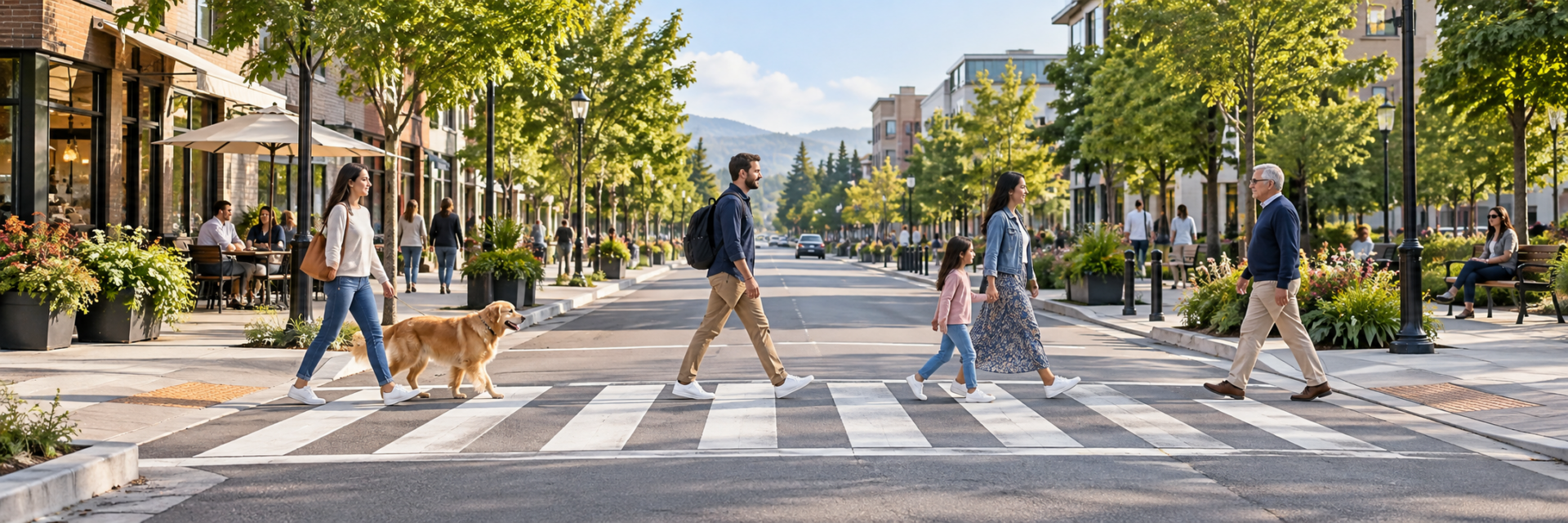
Daylight saving time ends on Sunday, November 1, 2026. Nothing about South Florida’s roads changes that morning, but by Monday evening thousands of people who were walking, biking and driving home in daylight are doing it in the dark. Pedestrian deaths climb in the weeks that follow, every year, and the reasons are predictable. Here is why it happens, what Florida law says about who is at fault, and what to do if you or someone you love is hit.
Why the first weeks of November are so dangerous
Nationally, roughly three out of four pedestrian deaths happen after dark, according to NHTSA. The end of daylight saving time pushes sunset into the evening rush hour, so the heaviest foot traffic and the heaviest vehicle traffic now overlap in low light. Drivers who were used to seeing clearly at 6 p.m. take weeks to adjust. Headlight glare, wet pavement from late-season storms, and unlit sidewalks make it worse.
South Florida adds its own problems. Many of our busiest corridors, including State Road 7, Broward Boulevard, Sunrise Boulevard, University Drive and US-1, have wide lanes, long gaps between signalized crosswalks, and bus stops placed mid-block. People cross where it is convenient rather than where it is marked, and drivers do not expect them. Florida’s pedestrian fatality rate is consistently among the highest in the nation, and Broward, Miami-Dade and Palm Beach counties account for a large share of it.
What the law requires of drivers and pedestrians
Florida’s pedestrian statute, section 316.130, cuts both ways.
- Drivers must yield to pedestrians in crosswalks, and that includes unmarked crosswalks: the extension of the sidewalk across an intersection is a crosswalk whether or not it is painted.
- Drivers turning right on red must stop and yield to pedestrians already in the crosswalk.
- Every driver must exercise due care to avoid hitting any pedestrian, regardless of where they are.
- Pedestrians crossing outside a crosswalk must yield to vehicles, and walking into the path of a car that cannot stop is negligence on the pedestrian’s part.
Because Florida uses modified comparative negligence, a pedestrian found partly at fault recovers less, and one found more than 50 percent at fault recovers nothing. The defense in almost every pedestrian case argues the walker “came out of nowhere.” Evidence of lighting, speed, distraction and sight lines is what answers that argument.
The crashes we see most after the time change
- Right-on-red turns made without scanning the crosswalk
- Speeding on poorly lit arterials, where stopping distance doubles
- Failure to yield at unmarked crosswalks
- Drivers blinded by oncoming headlights on roads without a median
- Distraction: the phone in the driver’s hand is the single most common factor
- Burned-out streetlights that have been reported and never repaired
When the government shares responsibility
That last point matters. If a streetlight has been out for months and complaints were filed, or a crosswalk was designed without adequate lighting, a city, county or the Florida Department of Transportation may share responsibility. Claims against government agencies come with written notice requirements and statutory damage caps, and the evidence (maintenance logs, complaint records) has to be requested quickly.
If you are hit
- Call 911, even if you feel okay. Adrenaline hides injuries, and the police report locks in the driver’s identity and insurance.
- Get witness names and numbers before they leave.
- Photograph the scene: the crosswalk, the lighting, the driver’s car and plate, your injuries.
- See a doctor within 14 days. Your own PIP coverage, or a household member’s, may pay your initial medical bills even though you were on foot, but only if you treat in time.
- Do not give a recorded statement to the driver’s insurer before you understand your claim.
- Do not accept blame at the scene. Where you were crossing is a question for the evidence.
What a pedestrian claim can recover
Medical care, lost income, pain and suffering, and, in a fatal crash, the damages Florida’s Wrongful Death Act provides to the family. Because pedestrians have no vehicle between them and the car, injuries tend to be catastrophic, and the at-fault driver’s policy is often too small. Your own uninsured/underinsured motorist coverage, the vehicle owner’s policy and any employer coverage all have to be examined.
Walk defensively, and call us if a driver didn’t
For the next several weeks, assume drivers cannot see you: wear light colors or a light, cross at signals even when it means a longer walk, and make eye contact before stepping off the curb. If a driver hits you anyway, we will find out why and who is responsible. Call The Injury Advocates at (754) 812-8444 or 833-DARFOOR, or send us a message. The consultation is free, and you owe no fees or costs unless we recover for you. Learn more about our pedestrian and bicycle accident practice.
Kweku Darfoor is the founder of The Injury Advocates (Darfoor Law Firm, P.A.), a member of The Florida Bar since 2014, and a Plantation-based personal injury attorney representing seriously injured people and their families across Fort Lauderdale, Broward County, and South Florida. This content is for general information and is not legal advice.